Description
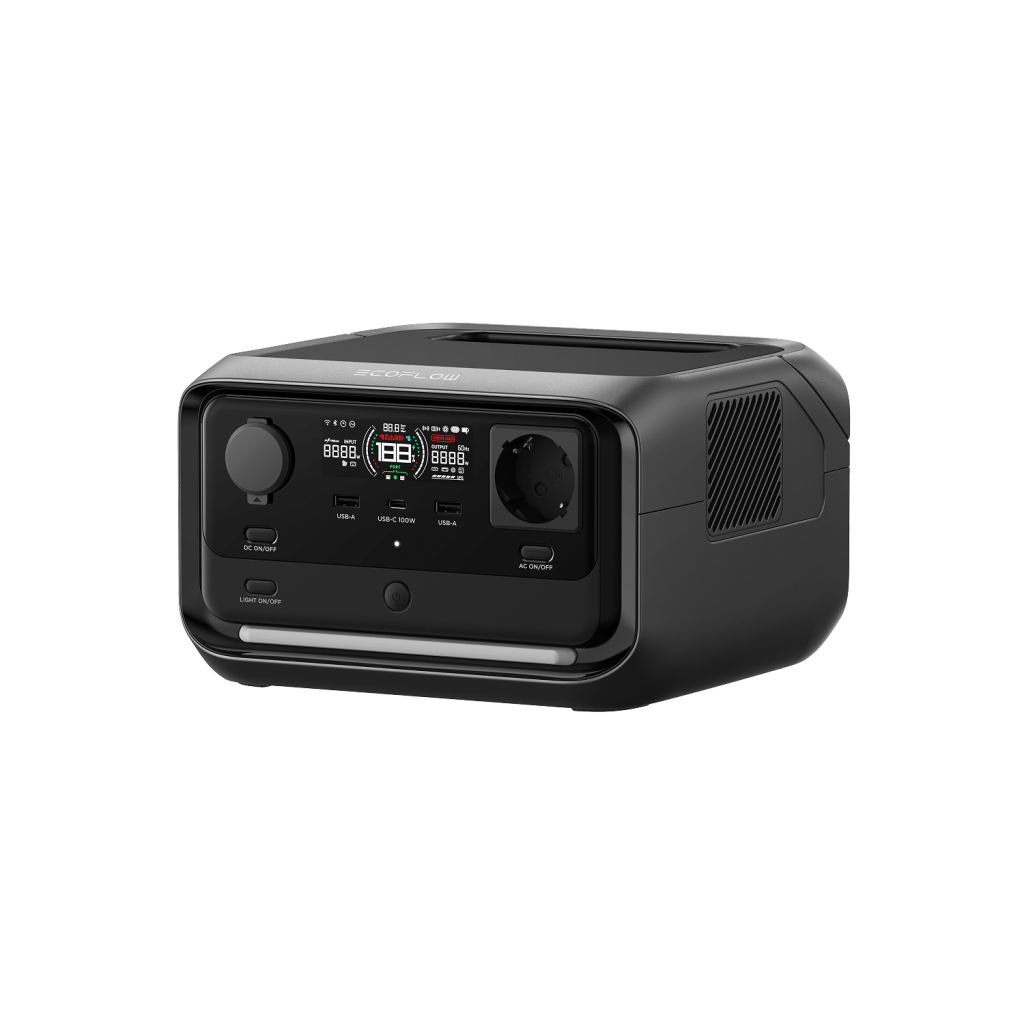
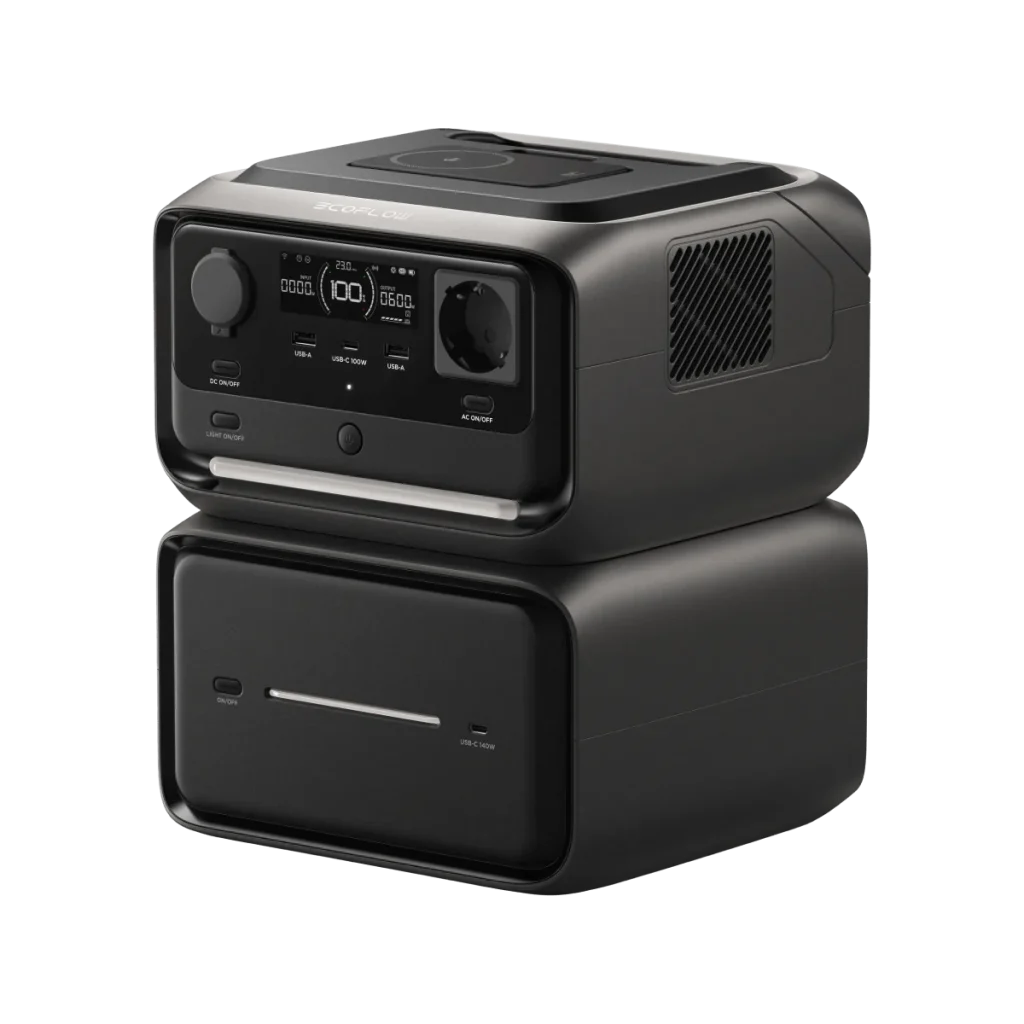
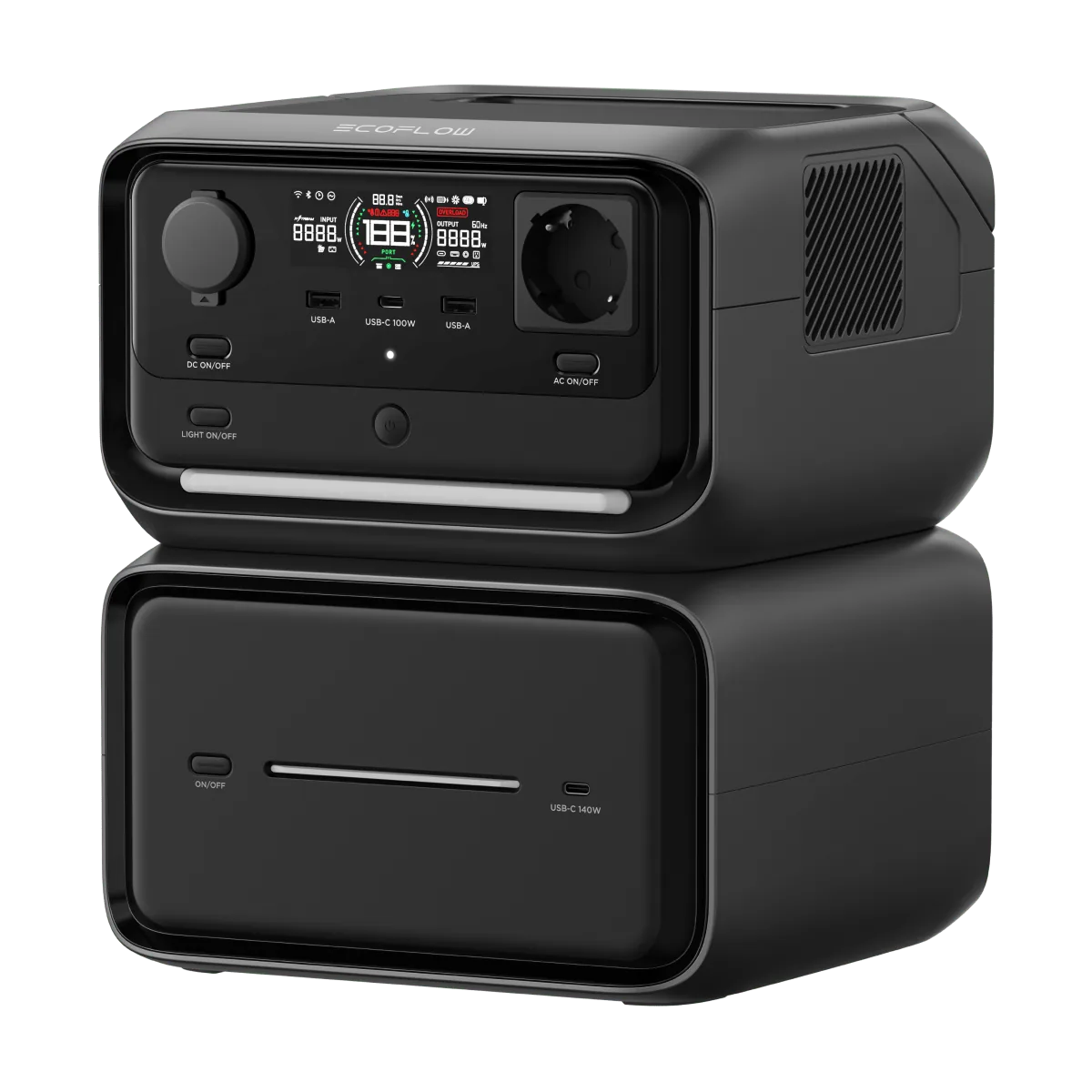
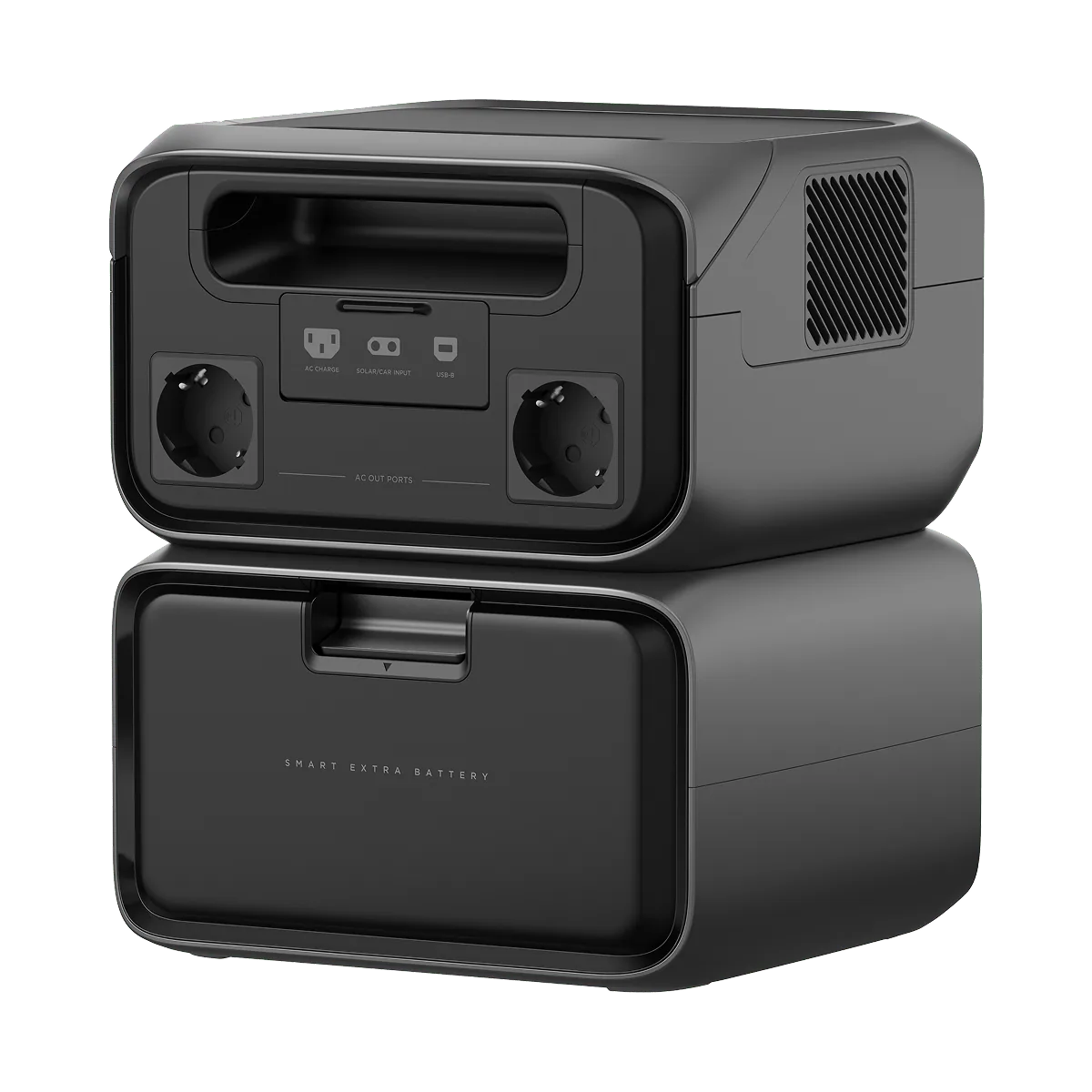
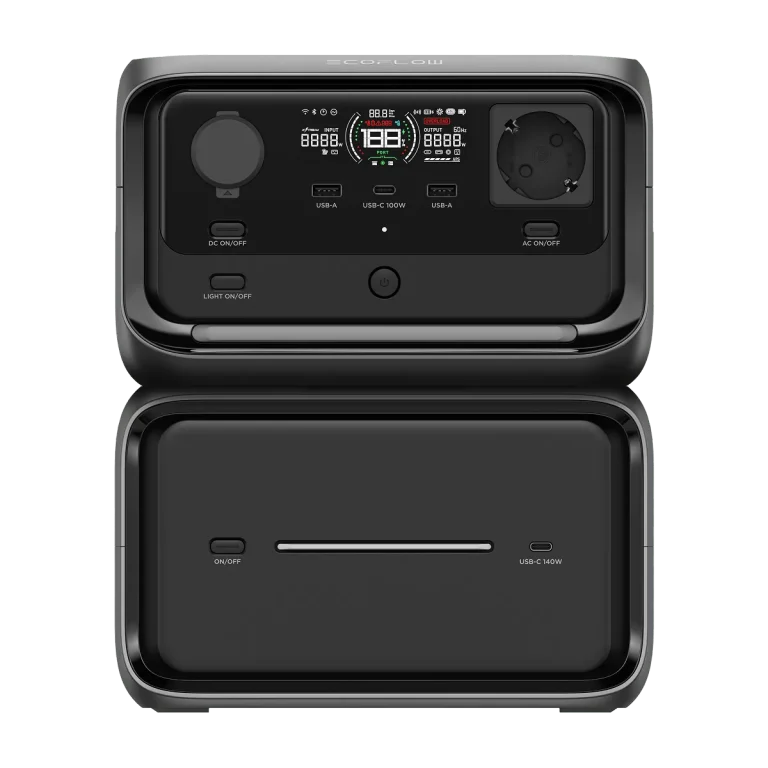
The EcoFlow RIVER 3 Max Plus is not a separate model but a ready-made set: a 286 Wh RIVER 3 Plus station and a 572 Wh EB600 extra battery that stack on each other. Together that is 858 Wh, the largest capacity the RIVER 3 Plus supports. If you plan to buy an EcoFlow RIVER 3 Max Plus, you get a system that does not need building up: the energy reserve is three times larger than the station alone, while the dimensions stay compact.
For scheduled outages this is no longer just a reserve for a router. The set keeps a fridge going for several hours, a PC workstation for about an hour at full load, and internet and lights for several days.
Why RIVER 3 Max Plus
858 Wh in two units
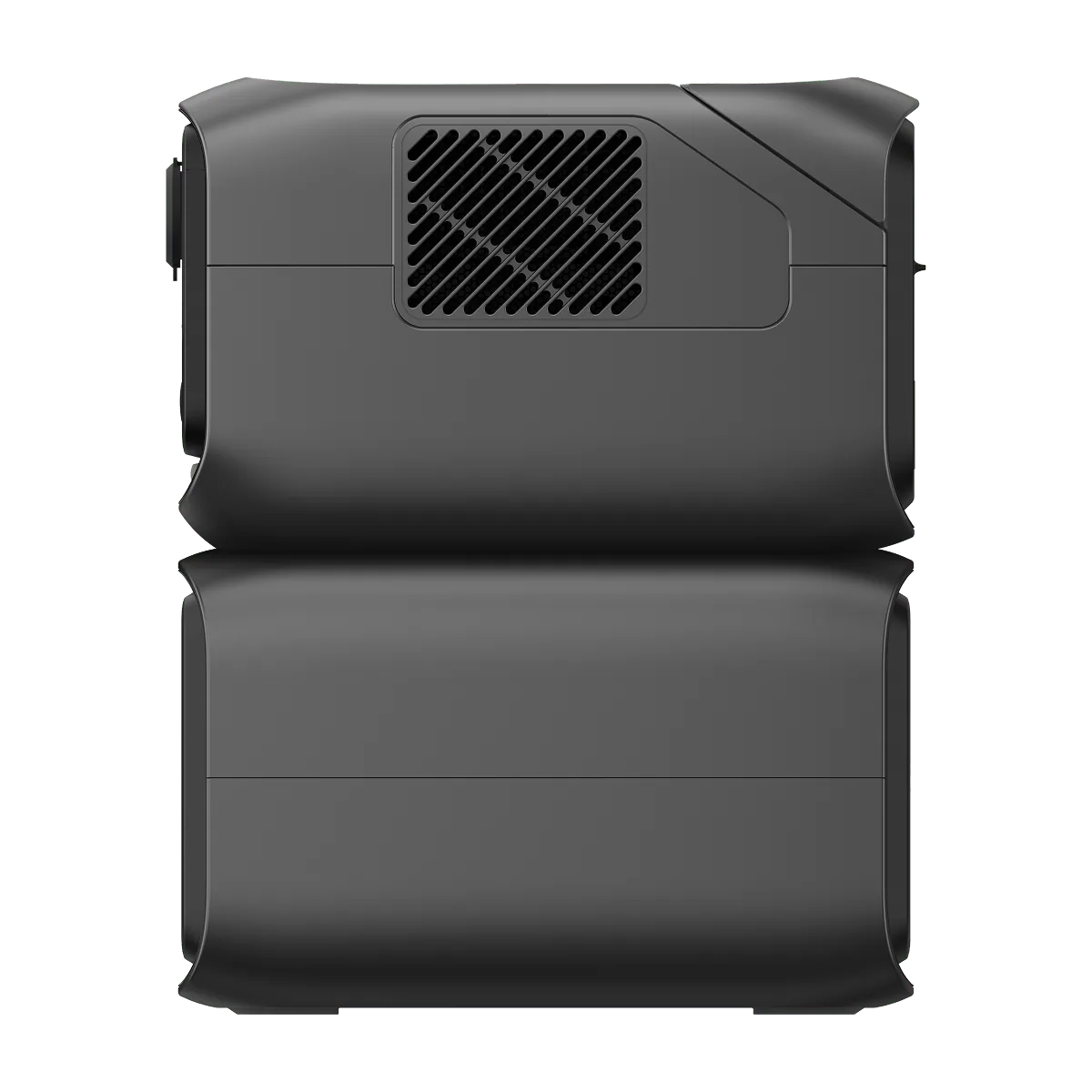
The station weighs 4.7 kg and the EB600 battery 5.8 kg, about 10.5 kg together. They can be carried separately: this is more convenient than a single station of similar capacity that has to be lifted whole. The battery goes under the station, the spring pogo pin contacts close by themselves and the latches hold the structure together.
The battery also works on its own
The EB600 has its own 140 W USB-C port through which it both charges and delivers energy. Take it off for a trip and you have a 572 Wh power bank for a laptop, camera or phones, while the station stays at home.
Faster charging from the mains
According to EcoFlow’s manual, when an extra battery is under the station, the mains input rises from 380 to 650 W. EcoFlow does not publish an exact charging time for 858 Wh, but a simple calculation gives at least 1.3 hours, and a little more taking the slowdown at the end of charging into account.
The same UPS and 600 W
The outlets, inverter and UPS mode here are from the RIVER 3 Plus: three Schuko outlets, 600 W, X-Boost up to 1200 W for heating appliances and switching to battery in under 10 ms. The difference is that with the EB600 the UPS holds the load three times longer.
How long equipment runs from 858 Wh
Below is EcoFlow’s lab data for the RIVER 3 Max Plus specifically. It should be taken as a guide: an old fridge or a gaming PC may consume more than stated.
| Device | Power | Run time |
|---|---|---|
| Travel router | 10 W | 61.1 h |
| Car fridge | 60 W | 11.7 h |
| Game console | 100 W | 6.7 h |
| Fridge | 120 W | 5.6 h |
| Desktop PC | 600 W | 1 h |
In an apartment during a four-hour outage the set comfortably covers a fridge and internet at the same time, and by our estimate leaves a reserve for lighting and phone charging. A 60 W laptop together with a router and terminal (about 80 W) will run for roughly 9 hours.
For a gas boiler with an 80–120 W pump this is about 6–9 hours, that is an evening and night rather than just an hour or two as from a single station. Powerful appliances of 2 kW and more the set will not run: the inverter limit is 600 W, and with X-Boost 1200 W for heaters.
A typical day without power
Suppose the power is off for 8 hours in the daytime and you work from home. A 60 W laptop, a 20 W router with a terminal and a 10 W LED lamp together take about 90 W, that is roughly 720 Wh over 8 hours. That is almost the whole usable reserve of the set, so on such a day it is better to connect the fridge for only part of the time. If outages are shorter, 4 hours each, the same set of equipment together with the fridge fits with a reserve. These are our estimates; check real consumption in the EcoFlow app.
For a weekend trip it is convenient to take the station with the battery in the car: a 60 W car fridge, per EcoFlow, will run for about 11.7 hours, and in the evening a lantern and phone chargers are powered from the same outlets.
How it works
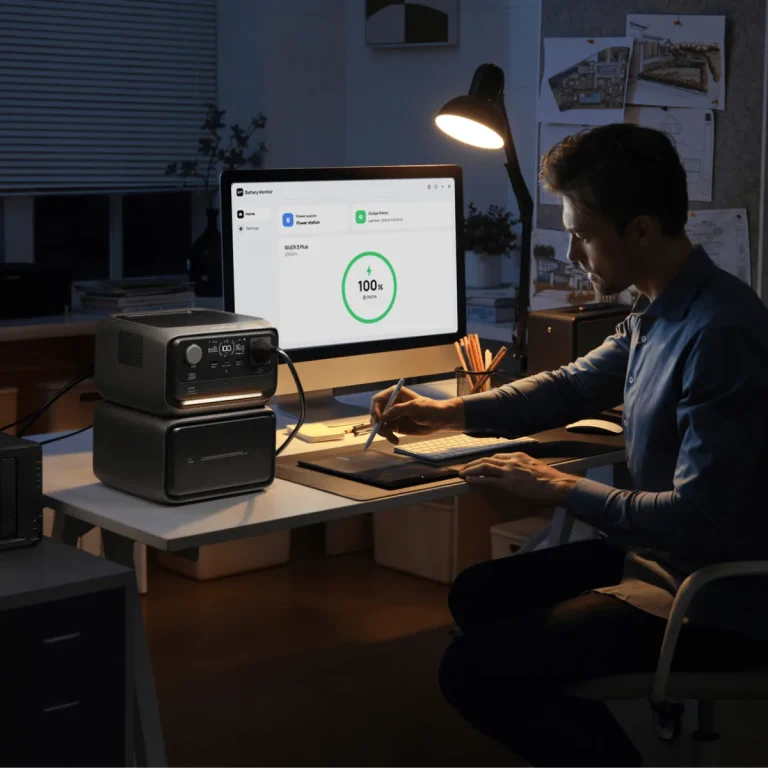
The set behaves like a single station. After connecting, both units switch on with the button on either one, a battery icon appears on the RIVER 3 Plus display and the EcoFlow app shows the total charge. If the charge levels differ greatly, when charging the weaker unit fills first, and when discharging the stronger one gives energy first.
The system can be charged from a socket, a petrol generator, solar panels up to 220 W or a car cigarette lighter through the station’s XT60i input. The solar input is the same as in the RIVER 3 Plus, so for 858 Wh even on an ideal day at least 4 hours are needed — this is our calculation, not EcoFlow data. The EB600 battery can additionally be charged through its USB-C from a 140 W charger.
The 220 W solar input in summer on a clear day works closer to its rating, but a panel’s real output is usually below its datasheet value. In winter a panel gives several times less, so 858 Wh cannot be gained from the sun alone in a short day. So in the cold months the main energy source for the set is the socket during the hours when mains power is available.
For a computer or NAS the box contains a USB-B to USB-A cable: through it and the EcoFlow PowerManager program the equipment receives charge data and shuts down by itself if the outage drags on.
Installing and removing the battery
According to EcoFlow’s manual the battery is installed like this: switch off both units, remove the protective cover from the connector on the bottom of the station, align the station’s groove with the protrusion on the top of the EB600 and lower the station so the connectors join. The installation has succeeded when a battery icon appears on the station’s display.
Disconnecting the battery is simple: switch off both units, press the release button on the EB600 and lift off the station. EcoFlow does not allow connecting and removing the battery on a switched-on system.
Set or separate units, Max or Max Plus
The RIVER 3 Max Plus has the same composition as a pair of EcoFlow RIVER 3 Plus and Extra Battery EB600 bought separately, and they work identically. The set is convenient because everything arrives in one order and is already matched. Buying separately makes sense if 286 Wh is enough for now and you plan to add the battery later.
| RIVER 3 Max Plus | RIVER 3 Max | DELTA 3 Classic | |
|---|---|---|---|
| Capacity | 858 Wh | 572 Wh | 1024 Wh |
| Power | 600 W | 600 W | 1800 W |
| Weight | ≈10.5 kg (2 units) | ≈8.2 kg (2 units) | 12.1 kg |
| Composition | Plus + EB600 | Plus + EB300 | one station |
The EcoFlow RIVER 3 Max is a RIVER 3 Plus with the smaller 286 Wh EB300 battery. It is 2.3 kg lighter and lower, but gives 572 Wh instead of 858. If a fridge or boiler is in your plans, the difference in run time is noticeable.
When 600 W is limiting, for example if you need a kettle, microwave or a pump with a high starting current, look at the EcoFlow DELTA 3 Classic: 1800 W and 1024 Wh in one case. And for a minimal reserve for a router and phones the EcoFlow RIVER 3 is enough.
Who the RIVER 3 Max Plus suits and who it does not
It suits you if:
- the power is off for 4–8 hours and a fridge, internet and laptop must work all that time;
- quiet operation by the workplace and a UPS for a PC matter;
- you want a separate 572 Wh power bank for trips;
- you have to carry the station up stairs — two 5 kg units are easier than one 10 kg.
It is worth choosing another option if:
- you need to power devices over 600 W without limits;
- you plan a solar system of several panels — the input here is only 220 W;
- short outages are enough for you, in which case the RIVER 3 Plus alone will do.
FAQ
What is the difference between the Max Plus and the regular Max?
The battery in the set. In the Max Plus it is the 572 Wh EB600, in the Max the 286 Wh EB300. The station is the same in both — the RIVER 3 Plus.
Can another battery be added to the set?
No. The RIVER 3 Plus accepts only one expansion battery, and the EB600 is the larger of the two, so 858 Wh is the limit.
Can the station be used without the battery?
Yes. The RIVER 3 Plus is fully self-contained: remove the EB600 and the station works as an ordinary 286 Wh one.
Can a phone be charged directly from the EB600?
Yes, through its 140 W USB-C port, even when the battery is detached from the station. It charges through the same port.
What is in the box?
Two units (the RIVER 3 Plus and the EB600), a mains power cable, a communication cable for a PC or NAS and paper documents. The solar and car cables are bought separately.
Can a kettle be switched on while the set works as a UPS?
Better not. While the mains is on, equipment is powered directly from it through the station, X-Boost does not operate in this mode and the total load on the outlets is limited to 600 W. A 1200 W kettle can be started when the set runs from the batteries.
How should I store the set between outages?
In a dry place at a temperature from -10 to 45 °C, preferably from 0 to 30 °C. If the set is not used for a long time, EcoFlow advises fully charging it once every 3 months and discharging it to about 60%.
What happens if the battery and station are charged differently?
The system equalises them by itself. During charging the unit with less charge fills first, and during operation the one with more charge gives energy first.
Can the EB600 be taken on a plane?
No. The battery’s manual directly forbids transporting it by air.
Summary
The RIVER 3 Max Plus is a RIVER 3 Plus taken straight to the maximum: 858 Wh, 600 W, UPS up to 10 ms and a battery that can be taken separately. Decided to buy an EcoFlow RIVER 3 Max Plus? The order button is at the top of the page. Not sure what to choose: Max, Max Plus or DELTA? You can send us your list of devices through the contacts page and we will answer with a calculation.